

 Back to List
VOILA! AI, Compute & Environment
Title
VOILA! AI, Compute & Environment
Lecturer
Julia Hess, interface
Maria Nowicka, interface
Content and organization
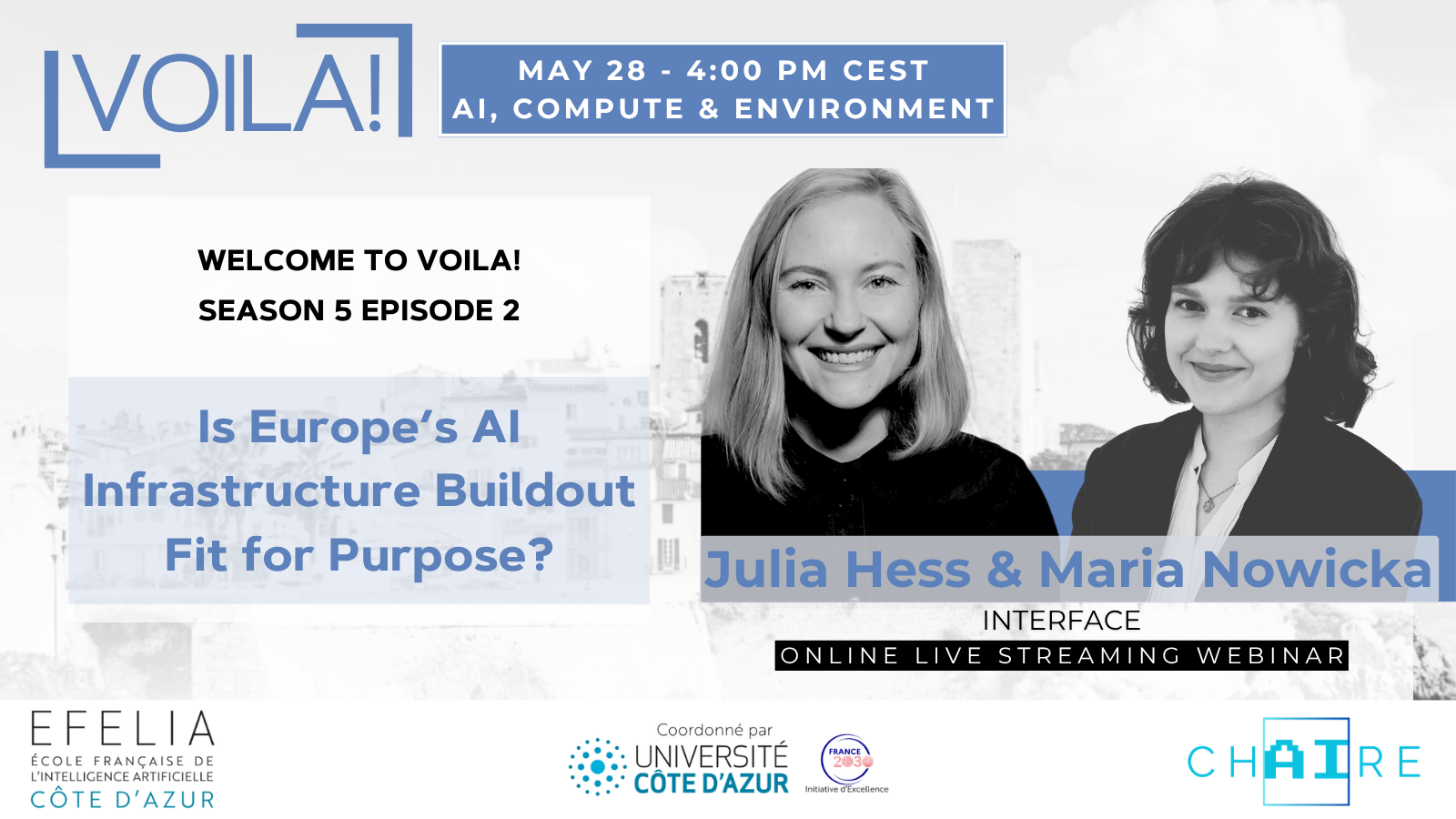
This talk argues that the question of whether Europe is building the right infrastructure for its actual needs is closely linked to environmental sustainability. Expanding compute capacity is not only a matter of scale, but also of purpose and design.
Drawing on recent publications from interface’s Global Chip Dynamics Programme, the presentation examines the environmental implications of the AI-driven build out of compute infrastructure. Particular attention is given to the climate and resource impacts of semiconductor manufacturing. The talk also explores a possible link between the recent rise in emissions from chip production and the AI boom. Energy represents another key dimension and an emerging bottleneck. Electricity demand from data centres is rising rapidly. This growth is closely tied to decisions about the purpose large-scale compute infrastructure is intended to serve – such as training or inference – and the hardware requirements resulting from that.
The talk concludes by connecting policy initiatives that are often treated in isolation. It highlights the second-order effects emerging across AI, semiconductor, and energy policy that remain largely absent from current debates.
Julia Christina Hess leads interface’s work on semiconductors through the Global Chip Dynamics Programme. Her research examines the strategic importance of semiconductors for Europe and the global, interdependent value chain, considering both its significant ecological footprint and evolving geopolitical context. An expert on semiconductor-related policies from national industrial strategies to chip diplomacy, Julia has spoken at national and international conferences, events, and hearings. Most recently, she presented her work as a subject matter expert during New York Climate Week and to the Committee on Industry, Research and Energy of the European Parliament. She is regularly interviewed or provides commentary for outlets including die Zeit, Süddeutsche Zeitung, Politico, Deutschlandfunk, Internationale Politik, and IPG Journal.
Maria Nowicka is a Policy Researcher for the Global Chip Dynamics programme. Her work explores the strategic role of semiconductors in shaping Europe’s economic resilience, tech sovereignty, and green transition, focusing on how geopolitical tensions shape supply security and industrial competitiveness. Prior to joining interface, Maria advised industry stakeholders on EU digital policy as a public affairs consultant at FleishmanHillard and gained first-hand insight into tech policymaking as a Blue Book Trainee at the European Commission. She holds a Master of Laws from Ghent University, where she examined the risks and protections introduced by early AI regulation in the context of digital rights.
Course Duration
1.5
Course Type
Short Course
Participation terms
Attendance is free and open to everyone interested. Please register via the course link, and you will receive the Zoom meeting details one day before the seminar.
Modality (online/in person):
Online
Notes
For AIDA students only : In addition to registering via the course link, please click on the “Enroll in this course” button located at the bottom of the page to ensure that the course appears on your AIDA Certificate of Course Attendance upon successful completion.