VOILA! Debunking LLMs Exhibiting the Known Sources of Possible Weaknesses: Hallucination, Fairness, Reliability

VOILA! Debunking LLMs Exhibiting the Known Sources of Possible Weaknesses: Hallucination, Fairness, Reliability

VOILA! Debunking LLMs Exhibiting the Known Sources of Possible Weaknesses: Hallucination, Fairness, Reliability
Title

VOILA! Debunking LLMs Exhibiting the Known Sources of Possible Weaknesses: Hallucination, Fairness, Reliability

Lecturer

Frédéric Precioso (Université Côte d'Azur), Frederic.PRECIOSO@univ-cotedazur.fr

Content and organization
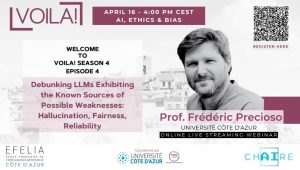
Prof. Frédéric Precioso, Université Côte d’Azur

Abstract : By presenting the key principles of LLMs, we will expose how core mechanisms are finally not so complex and how they allow many failures to arise. We will present some of the most recent fancy techniques, such as self-distillation and Reinforcement Learning from Verifiable Reward (RLVR), and how they do not really solve the known weaknesses but potentially open new fields of application and pave the way to apply LLMs efficiently. We then provide insights on evaluation approaches and the persistent limited reliability of the models. We finally expose the ethical implication of such technical choices, presenting the studies of AI biases and fairness.

Speaker’s BIO: Frédéric Precioso is a Professor of Computer Science at Université Côte d’Azur. He has made methodological contributions to areas of artificial intelligence, machine learning, and deep learning, such as explainability, hybridization of symbolic and non-symbolic AI, knowledge injection, low-data domains of expertise (medicine, social sciences). Professor Precioso was appointed to the French National Research Agency (ANR) where, from 2018 to 2023, he was in charge of programs associated with the National AI Plan within the Directorate of Major State Investment Projects and the Department of Digital Sciences and Mathematics. He was responsible for all ANR funding instruments related to the French artificial intelligence strategy.

Course Duration

1,5

Course Type

Short Course

Participation terms

Attendance is free and open to everyone interested. Please register via the link above, and you will receive the Zoom meeting details one day before the seminar.

Modality (online/in person):

Online

Host Institution
Université Côte d'Azur

Other short courses

10. 12. 2025 Go

Ethics & STICs

11. 03. 2025 Go

Deep Learning

13. 02. 2025 Go

Ethics and AI

13. 02. 2025 Go

Computer Vision

19. 01. 2025 Go

Ethics & STICs

10. 04. 2024 Go

Ethics & STICs

01. 03. 2024 Go

Computer Vision

24. 11. 2023 Go

Human Rights Toolbox

21. 02. 2023 Go

Computer Vision

11. 05. 2022 Go

Geometric learning

05. 04. 2022 Go

Computer Graphics

04. 04. 2022 Go

Bayesian Learning

02. 04. 2022 Go

Computer Graphics

31. 03. 2022 Go

Web of Data

28. 03. 2022 Go

Machine Learning

27. 03. 2022 Go

Machine Learning

02. 03. 2022 Go

Player Modeling

28. 02. 2022 Go

Player Modeling

21. 02. 2022 Go

Affective Computing
21. 02. 2022 Go

Machine Listening

21. 02. 2022 Go

Computer Vision

21. 02. 2022 Go

Computer Vision

21. 02. 2022 Go

Self-Driving Cars

21. 02. 2022 Go

Deep Learning

21. 02. 2022 Go

Deep Learning 2

09. 07. 2021 Go

Self-Driving Cars

09. 07. 2021 Go

Computer Vision

09. 07. 2021 Go

Deep Learning

17. 06. 2021 Go

Deep Learning School

17. 06. 2021 Go

Memory Network

02. 06. 2021 Go

Machine Listening

02. 06. 2021 Go

Affective Computing

02. 06. 2021 Go

Deep Learning 2

01. 06. 2021 Go

Computer Vision